slide
1 of 2
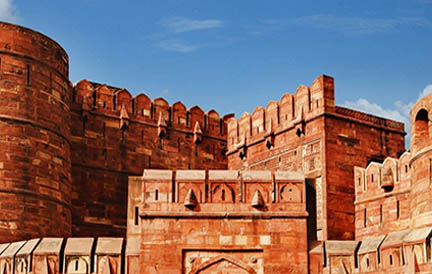
Agra Fort Uttar Pradesh
Agra Fort, as we know it today, is a colossal masterpiece built by the most popular Mughal Emperor, Akbar in 1565 AD, followed by Shah Jahan. Prior to Akbar, the fort served as a residence of Babur, while Humayun was crowned as an emperor in it. It is one of the three UNESCO World Heritage Sites in Agra, apart from Taj Mahal and Fatehpur Sikri. This splendid monument is also known as Lal Qila and Qila-I-Akbari, because it is built out of red sandstone. Inside the fort, you come across several buildings which embody aesthetic perfection and magnificence. No heritage tour to UP is complete without visiting the Agra Fort.
Indeed, the structure, layout and design of the fort suggests an empire at the height of its glory and fame. This massive structure, which brilliantly combines aesthetics with size, served as the capital of the Mughal Empire till 1638, when it was finally shifted to Delhi. Although the fort was commissioned by Akbar and constructed under his supervision, later additions were made to it by Shah Jahan (who was an admirer of grand structures) and Jahangir.
Some of the magnificent buildings which captivate the onlookers inside the fort are, Diwan-i-Aam and Diwan-i-Khas (two audience halls), Nagina Masjid, Akbar’s Mahal, Bengali Mahal, Khaas Mahal and Jahangir’s Palace. It is not until you begin exploring this enormous structure that you realize its importance, both historically and culturally. Just like most other architectural masterpieces, there is a legend associated with this structure too. It is believed that the royal rooms of the fort were first made hollow and then filled with water in order to enable them to remain cool even during summer. It was also a cruel twist of fate that one of the buildings in the Agra Fort built by Shah Jahan, the Musamman Burj, later served as his prison after he was deposed by his son, Aurangzeb.
Architecture
Agra Fort, which always finds a mention in the list of heritage attractions in UP, is built mainly of red sandstone with the bricks forming its base. Emperor Akbar built many structures within the fort under his supervision, each as magnificent as the other. During the reign of Shah Jahan however, some of the structures were first destroyed and then rebuilt using white marble, for which he harbored a special love.
Inside the fort, there are various structures which reflect the grandeur of the Mughal Empire and are the finest examples of Indo-Islamic architecture. While the Agra fort’s walls boast a circumference of about 2.5 km, they rise almost 21m high and are surrounded by a moat.
The fort consists of two gates - Delhi Gate and Lahore Gate, which is also known as Amar Singh Gate. Tourists can enter the fort only through the Amar Singh Gate.
The structures which captivate visitors’ attention inside the fort are, Jahangir’s Hauz, Babur’s Baoli, Shah Jahani Mahal, Nagina Masjid, Diwan-i-Aam, Diwan-i-Khas, Musamman Burj, Khas Mahal, Sheesh Mahal, Bengali Mahal, Akbar’s Mahal and Jahangiri Mahal. Among these, Jahangiri Mahal is the largest of all structures. The Pearl Mosque, also known as Moti Masjid, is an exercise in unmatched perfection.
Best Selling Packages
Popular Packages in Uttarpradesh
slide 1 of 2

PATNA SAHIB TOUR
3 Nights -
4 Days

DARGAH TOUR IN INDIA
5 Nights -
6 Days

JAIN PILGRIMAGE TOUR UTTAR PRADESH
5 Nights -
6 Days

JAIN PILGRIMAGE TOUR OF NORTH INDIA
5 Nights -
6 Days

Village Tour to Varanasi
6 Nights -
7 Days

Agra Weekend Tour
2 Nights -
3 Days

Jaipur - Agra Weekend Tour
2 Nights -
3 Days